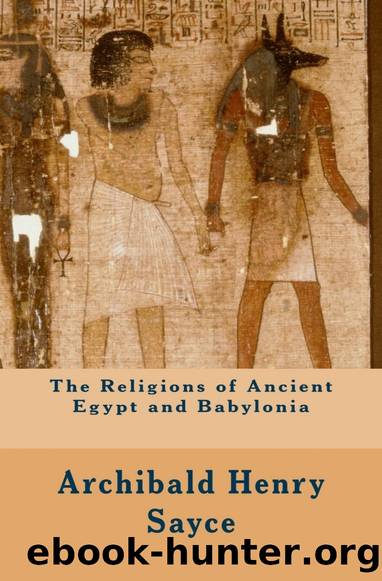
The Religions of Ancient Egypt and Babylonia by A.H. Sayce
Author:A.H. Sayce [Sayce, A.H.]
Language: eng
Format: epub
ISBN: 9781517453503
Google: DvQ7jgEACAAJ
Barnesnoble:
Published: 2011-04-12T00:00:00+00:00
Lecture III. The Gods Of Babylonia.
I have already had occasion to refer to one of the gods of Babylonia, En-lil or El-
lil of Nippur.232 His worship goes back to the earliest period of Babylonian history; his sanctuary at Nippur was one of the oldest in the land. He belongs to
the period when the Sumerian was still supreme, and the name he bore was the
Sumerian title of En-lil, âthe lord of the ghost-world.â But it was a title only; the
âlord of the ghostsâ was himself a ghost, albeit the chief among them.
The fact must be kept carefully in mind. As yet there was no god in the proper
sense of the term. The superhuman powers that were dreaded and propitiated
were ghosts only, like the ghosts of dead men; and, like the latter, they were denizens of the grave and the underground world. It was only at night that they
emerged from their retreat, and terrified the passer-by. Primitive man fears the dark as much as does the child; it is then that the powers of evil are active, and
spiritual or supernatural foes lurk behind every corner ready to injure or destroy
him. The ghosts of the night are accordingly objects of terror, harmful beings from whom all forms of sickness and insanity are derived.
But even these ghosts can be controlled by those who [pg 298] know the magic
words or the mystic rites which they are compelled to obey. Between the ghost
and his victim the sorcerer or medicine-man can interpose, and by means of his
spells force the spirit to quit the body of the sufferer or enter the body of an enemy. By the side of the ghost, therefore, stands the sorcerer, who is at once the
master and the minister of the spirit-world.
With the progress of civilisation an organised body of sorcerers necessarily
grows up. But an organised body of sorcerers also implies an organised body of
spirits, and an organised system of controlling them. The spells and charms
which have been handed down from the past are formed into a system, and the
spirits themselves are classified and defined, while special functions are assigned
to them. The old unorganised animism passes into an organised shamanism, such
as still prevails among certain Siberian tribes. The sorcerer is on the high road to becoming a priest.
Between the sorcerer and the priest, however, there is a gulf too wide to be spanned. The religious conceptions presupposed by them differ in kind as well as
in degree. The nature of the superhuman beings by whom man is surrounded,
and the relations which he bears to them, are essentially different in the two cases. The priest may also be a sorcerer, but the sorcerer cannot be a priest.
Can shamanism develop naturally into theism, and the sorcerer into the priest?
Or is there need of foreign influences and of contact with other ideas and religious beliefs? I should myself be inclined to adopt the second alternative.
Theism may absorb shamanism, and the priest throw the ægis of his authority over the sorcerer, but the natural development of the one into the other is contrary to the facts of psychology as well as to those of history. The evolution
of a god out of the [pg 299] shamanâs ghost may be conceivable, but no evidence
for it exists. The superstitions and beliefs of shamanism linger, indeed, under a
theistic religion, and the polytheism of Babylonia was no exception to the rule.
Up to the last the magician flourished there, and the spells he worked were recognised by the religion of the State. But for all that they stood outside the religion of the State, harmonising with it just as little as the superstitions of popular folk-lore harmonise with the religion we profess. No one would assert that the Christianity of to-day has grown out of beliefs like that in the vampire
which still holds such sway in some of the Christian countries of Europe; and there is just as little reason for asserting that the vampire of the primitive Sumerian developed into a Babylonian deity. They represent two diverse
currents of belief, which may for a time run side by side, but never actually coalesce.
Babylonian tradition itself bore witness to the fact. The Chaldæan historian
Berossos tells us that the elements of culture, and therewith of the organised religion of a later day, were brought to Babylonia from abroad. Oannes or Ea, the
culture-god, had risen morning by morning out of the waters of the Persian Gulf,
and instructed the savage races of the shore in the arts of life. It was not from Nippur and the worshippers of En-lil, but from that mysterious deep which
connected Babylonia with other lands, that its civilisation had come. It was Ea who had taught men âto found the templeâ in which the gods of aftertimes were
to be adored. The culture-god of Babylonia was Ea, and the home of Ea was not
in Babylonia, but in the deep.
There is no mistaking the significance of the legend. The culture of Babylonia originated on the seacoast, and was brought to it across the sea. The elements of
civilisation were due to intercourse with other lands. [pg 300] And this
civilisation was associated with a godâwith a god, too, who represented all the
higher aspects of Babylonian religion, and was regarded as the author of its sacred books. The impulse which transformed the âlord of the ghost-worldâ into
a god, and replaced the sorcerer by a priest, came not from within, but from without.
The impulse went back to that primitive age when Sumerian supremacy was still
unquestioned in the land. Other races, so the legend averred, were already settled
there, but they were all alike rude and savage âas the beasts of the field.â How
far distant it may have been in the night of time we can but dimly conjecture. At
the rate at which the northern coast of the Persian Gulf is being slowly silted up,
it would be at least eight thousand years ago when the old seaport of Eridu and
the sanctuary of its god Ea stood on the shores of the sea. But the influence of
the Semite was already beginning to be felt, though indirectly, through maritime
trade.
New ideas came from the south. Ea was a god, and like the gods of the Semitic
race he had a wife and son. While he himself was lord of the deep, Dam-kina, his wife, was the mistress of the land. His son was Aṡari, âthe prince who does
good to man,â233 and who, in contradistinction to the night-demons of Nippur, brought knowledge and healing to the men whom Ea had created. The Sumerian
might indeed speak of the âZiâââthe spiritââof Ea, or rather of the deep, but to
the Semite he was a veritable god.
At the same time it was the conception only of Ea and his family which we need
trace to a foreign source. Their names are purely Sumerian, and their origin consequently [pg 301] must be Sumerian too. Doubtless they had once been
mere lils or ghosts, belonging to the ghost-world of the god of Nippur, and the spells taught by Ea to mankind were survivals from the day when the sorcerer was still his priest.
Download
This site does not store any files on its server. We only index and link to content provided by other sites. Please contact the content providers to delete copyright contents if any and email us, we'll remove relevant links or contents immediately.
Personalized inhaled bacteriophage therapy for treatment of multidrug-resistant Pseudomonas aeruginosa in cystic fibrosis by unknow(218869)
CONSORT 2025 statement: updated guideline for reporting randomized trials by unknow(102565)
Critical evaluation of the ProfiLER-02 study design and outcomes by Vivek Subbiah & Razelle Kurzrock(102111)
Cardiac gene therapy makes a comeback by Oliver J. Müller & Susanne Hille & Anca Kliesow Remes(101874)
Whisky: Malt Whiskies of Scotland (Collins Little Books) by dominic roskrow(74663)
Unveiling the design rules for tunable emission in graphene quantum dots: A high-throughput TDDFT and machine learning perspective by Şener Özönder & Mustafa Coşkun Özdemir & Caner Ünlü(51010)
A yeast-based oral therapeutic delivers immune checkpoint inhibitors to reduce intestinal tumor burden by unknow(40387)
Covalent hitchhikers guide proteins to the nucleus by Alexander F. Russell & Madeline F. Currie & Champak Chatterjee(40308)
Meet the Authors: Christopher R. Mansfield and Emily R. Derbyshire by Christopher R. Mansfield & Emily R. Derbyshire(40225)
Alkaline-earth metals promote propane dehydrogenation with carbon dioxide through geometric effects: Altering the reaction pathway by unknow(32823)
Induced iron vacancies boosting FeOOH loaded on sustainable Fenton-like collagen fiber membrane for efficient removal of emerging contaminants by unknow(32622)
Efficient electric-field-assisted photochemical conversion of methane to n-propanol exclusively over penetrated TiO2Ti hollow fibers by Guanghui Feng(32538)
Bi2SiO5 nanosheets as piezo-photocatalyst for efficient degradation of 2,4-Dichlorophenol by Hangyu Shi & Yifu Li & Lishan Zhang & Guoguan Liu & Qian Zhang & Xuan Ru & Shan Zhong(32479)
A novel NDIPTA organic heterojunction photocatalyst with built-in electric field for efficient hydrogen production by Jiahui Yang & Baojun Ma & Yongfa Zhu(32453)
Enhanced conversion of methane to liquid-phase oxygenates via hollow ferrite nanotube@horseradish peroxidase based photoenzymatic catalysis by Jun Duan & Shiying Fan & Xinyong Li & Shaomin Liu(32413)
Ordered macroporous superstructure of defective carbon adorned with tiny cobalt sulfide for selective electrocatalytic hydrogenation of cinnamaldehyde by Xiao-Shi Yuan & Sheng-Hua Zhou & San-Mei Wang & Wenbo Wei & Xiaofang Li & Xin-Tao Wu & Qi-Long Zhu(32347)
What's Done in Darkness by Kayla Perrin(27274)
Topological analysis of non-conjugated ethylene oxide cored dendrimers decorated with tetraphenylethylene: Insights from degree-based descriptors using the polynomial approach by A Theertha Nair & D Antony Xavier & Annmaria Baby & S Akhila(26641)
Investigation of mechanical and self-healing properties of hydroxyl-terminated polybutadiene functionalized with 2-ureido-4-pyrimidinone by Mohsen Kazazi & Mehran Hayaty & Ali Mousaviazar(26563)
